Monday, September 7, 2009

THE ERROR OF MY WAYS

September 6, 2009

Happy Birthday to my youngest, turned 18 today. Normally we would have a party or go somewhere for a birthday in our family, but today was different. For her present, she wanted to go to Disneyland with her boyfriend, not with her family. As much as we would have preferred another plan, we gave in to her request. That meant that I had the day free to climb. I sent Roy an e-mail and he replied he'd be by at 0700.

I had asked around the house if anyone else wanted to go and the answer appeared to be no when I looked around at departure time and saw everyone was asleep. Roy showed up on time and off we went. For some reason we ended up starting late, it may have had to do with a more leisurely breakfast than normal, oh and also the fact I forgot my hiking shoes and so we had to run back to the house.

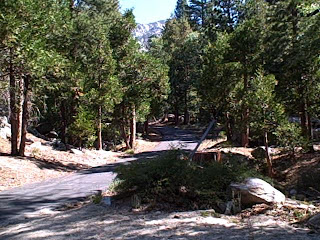
The weather reports had predicted temperatures in the mid to high 80s in Idyllwild, so we figured it would be prudent to climb one of the north facing routes on Tahquitz Rock. We hiked on up to the rock without too much apparent difficulty and noticed that there were more climbers than normal. I believe that we saw more climbers than on any other day this season. I suppose that could be due to the fact that it was Labor Day Weekend. When we reached the base of the rock we ran into a belayer at the base of the North Buttress. He was about 30 or 40 feet to the left of where Roy and I had started our climb of the North Buttress route. Since there are many possible route combinations on the buttress, I assumed that they were climbing the North Buttress route and told the belayer that we had climbed it a few weeks earlier. Small chat over, we continued to the west along the base of the rock. Roy wondered what climb we were going to do and I told him I was thinking of either The Error or Sahara Terror. both climbs are close together and offer some excellent climbing at their grades. I suspected that we would have to take which ever one was open, considering how many climbers we saw, but both we untaken and so we jumped on The Error, it being the closer of the two.


Roy getting the rope ready for the climb

The Error was first climbed in 1952 and is rated 5.6, for many years it was not nearly as popular as it's neighbor, Sahara Terror. When I finally got around to climbing it the first time, I was in for quite a surprise, what it lacked in technical difficulty it more than made up for in other areas, such as exposure, route finding and challenging protection. I have thought ever since that it is one of the under appreciated climbs on the rock.


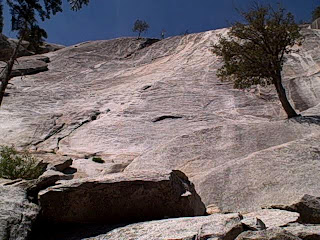
Looking up the climb from the base of the rock, climb heads up to the tree on the left skyline

The first 200 hundred feet consists of mostly easy scrambling up a gully to a little below a large roof. This gully is fairly wide and the left side is normally used to approach the Error, while more towards the right is taken to approach Sahara Terror. I stopped for the belay about 35 feet below a large roof which is the landmark feature of the climb.

Looking down the first pitch

Looking up at the roof from the first belay

There is a large ledge about 30 feet below the large roof, one can make a traverse right onto this ledge and then follow a crack to the roof. This has been the standard route for many years, but there is a large block of rock that has been sliding toward the edge of the ledge that is starting to look rather precarious. I opted to stay in the left corner and then go up to an undercling which took me over to the weakness in the roof. Since I knew from experience that there can be a tremendous amount of rope drag going over this roof, I set up a belay after a short pitch, just below the roof. I think Roy thought that I set up the belay at that location just so I'd have a softer landing in case I fell. No way, he's too bony.

Looking back at the traverse to the roof

Roy climbing up to the base of the roof

Looking up from the base of the roof

The weakness in the roof on the Error is about 30 feet right of the corner. There are more difficult ways to cross over the roof, but those weren't in our game plan for the day. The weakness has two options, separated by a flake of rock. I have climbed both sides of the flake over the years and have chosen the right side the last several times. I think the left side may be better protected, but the right side has some more positive holds. Going off the small ledge where the belay was set up, one grabs the top of a flake, kind of like grabbing the top of a door, only much more solid. Then you work your feet up till you can mantle on top of this flake. The handholds at this point in time become somewhat nebulous and balance becomes the paramount concern. Once you have fully stood up, you can reach some really good horizontal cracks that have great handholds as well as provide good protection. At this point the difficulties of the roof are finished and you move up into a steep corner.

Looking down from the rest at the top of the roof

The corner has beautiful white rock, very slick beautiful white rock. But what really adds to the fun at this point is the crack, or lack of one. There is a seam, which will take protection in very few places and that protection seems marginal at best. I decided I wanted to be little more confident, so I traversed left onto the edge of the corner.

Looking back at the traverse above the roof

The climbing was easier and better protected. It was also a little more "airy". I went on up to some steep sections of rock and started to work my way left. This climbing was enjoyable and soon I had run out of rope and set up the belay on another large ledge.

Looking up from the large ledge at the end of the third pitch

Roy belaying on the large ledge

The large tree on left was the belay at the top of the fourth pitch

I noticed at this time we were very close to the climbers that we had seen at the base of the North Buttress. We continued up another easy pitch and arrived at the prominent ledge at the top of the North Buttress. As summer is nearing the end and the days are getting shorter, our climb was in the shade all day long. We also had a fair amount of wind at times and on this ledge we came close to being chilled.

Several routes meet on this ledge and the climber I had spoken to at the base of the rock was setting up to belay his partner. We said "Hi" and I brought up Roy while he belayed up his partner. Once Roy arrived, I decided to climb up a steep corner that goes past a very unusual pine tree. It is growing out of a vertical crack and the trunk is horizontal at the beginning and then makes a 90 degree turn and is vertical like a normal tree. I thought it would be a good idea to climb this route so we wouldn't cross over the rope of the other party. We also would have run into a party of four who were on the Larks, so the finish would have been crowded. As I started to climb, the other party on the ledge asked if we knew which way their finish was. I said sure and pointed out the finish for the North Buttress route. The climber I had spoken to on the ground at that time told his partner that I had climbed the route two weeks ago and should know what I was talking about. Then his partner said they were climbing Lip Up Fatty (5.8) and that is finishes between the North Buttress finish and the finish we were climbing. I quickly admitted that their route was unknown to me and I didn't know which way they should go. I have to admit that I was a little embarrassed.

Looking down the fourth pitch

I continued up the steep corner and found the climbing to be delightful. I had first climbed it on a warm day, in full sun about 35 years ago and thought it pretty tough at the time, maybe about 5.8 or so. I couldn't believe how everything seemed to just flow for me on this pitch. I recalled having climbed it on another occasion and it seemed fairly reasonable at that time, but I was also climbing at a much higher level. When I reached some nice ledges I set up the belay and brought up Roy. As much as I had enjoyed this pitch, Roy disliked it. I suspect that the main reason was that is was a modified chimney pitch and Roy was climbing with a pack on. Some climbers love chimneys and some hate them, but no one likes them when having to climb with a pack on, so Roy suffered on that one. I'll have to arrange for him to climb it without the pack sometime so he can enjoy it too. Once back at home I checked my old guidebooks and found that this pitch is part of the Uneventful 5.5.

Looking down the chimney pitch (5)

Near the end of the chimney pitch

The next pitch was as much a scramble as a climb and it went quickly. Roy asked me if I thought I was soloing when he arrived at the belay, because I had placed so few pieces of protection. On this pitch I kept expecting to run into the climbers on Lip Up Fatty, but we never saw them again.

Roy on next to last pitch (6)

The last pitch (7) ended just past the tree

The last, or seventh pitch was another short one and again just a scramble, but Roy assured me that he didn't feel cheated, he had had a full days worth of climbing. I suspect the fact that he was breaking in a new pair of climbing shoes didn't help either.


I'm not sure if Roy was breaking in the shoes, or the shoes breaking Roy

Our finish was just below the true summit of Tahquitz, but we both said, "been there, done that" and we quickly packed up and hiked back down to the car.

View at the finish of the climb

Roy demonstrates how the rock hit the tree like a "machete"

After we left the East Gully we opted for the traditional descent that down climbs some exposed face and then drops into a gully with some tricky chimney down climbing. We decided that there was a reason for not using this route in the past few years and it's not because we don't leave our packs at the base of the climbs.

Desperate downclimb

Another good day for the old timers. Below is a video of the climb


Sunday, August 30, 2009

Getting Away for Little Murders

August 29, 2009

I had big plans for the day, my old friend from high school and college days contacted me and asked if I was available to take him and his boys on a climb of Tahquitz Rock. I was thrilled and said yes right away. As the time got closer, things began to change. Southern California is having a heat wave, hottest of the summer. With the heat, we started seeing major wildfires breaking out around the state, but mostly here in the southland. My regular climbing partner, Roy is getting ready to retire and playing it to the hilt. He has decided that he's getting old and cranky. Of course I don't have the nerve to tell him he's always been old and cranky, so I just kind of play along. He decided about mid week that with the size of the party and hot weather, he didn't want to go. He likes to remind me of trips we've taken where we hike back in the dark, with inadequate lighting, like Middle Cathedral Spire in Yosemite, Monument Peak near Lake Havasu and perhaps one or two others. My retort is, we made it back didn't we. To which Roy gives a sad knowing smile as he nods his head. Of course I don't know what it is he is knowingly smiling about, nor do I think I want to, best to leave it alone I figure. Anyway, I digress, by the end of the week my old school buddy decided that heat and air quality were getting too poor to be able to enjoy climbing, so they bailed as well.

Now, I treasure my opportunities to get out and enjoy nature, so I was at a loss. I started thinking about going to the beach, with about everyone else in California, I figured about with luck I might be able to park with-in a quarter of a mile of the water and then have a space of two and a half feet by six feet all to myself. Needless to say, my attitude could have been better. Then, to my surprise, my youngest daughter came up to me and asked if I could take her and her boyfriend on a little climb. I said of course and we started planning. By 10:30 pm on Friday we still hadn't completed the details and I went to bed.

At 6 am my daughter woke me and said let's get ready and go. I like her spirit. She then told me that the boyfriend bailed and it would be just the two of us. We packed up and off we went. We arrived in Idyllwild and sure enough, it was already getting warm. I decided to climb at Suicide Rock since with the shorter routes, we would be able to easily call it quits if conditions were unbearable. I was pleasantly surprised that the closest fire, the Cottonwood fire near Hemet, only about 12 miles away wasn't a factor.


Part of the approach hike

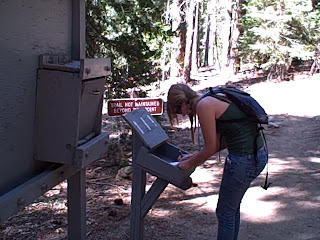
The permit process

Due to the warm temperatures, we hike slowly with plenty of rests up to the base of the rock. It was unusual not to see anyone at the Weeping Wall, but no one in their right mind would be climbing that wall in the direct sun with these temperatures.


Weeping Wall

We continued around the rock to the north and arrived at the north face area. There was a group on the Flower of High Rank and another party getting ready to climb the Guillotine. We only saw one other party all day, and they were hiking up as we were hiking down.


A climber on Flower of High Rank

I decided to climb in the shade so we positioned ourselves at the base of Little Murders, a climb that I always enjoy. My daughter Charlene hasn't climbed much, mostly friction face routes so I knew this was going to be a challenge for her. She was going to get to do some laybacking, chimney and undercling moves, in addition to cleaning traditional protection. I headed up the climb after a quick refresher on how to belay. As I climbed I was careful to make sure I placed the protection where there were good rest stances. Little Murders is a short climb, about half a pitch long so I was able to make good time, or so it seemed to me, Charlene may have another version. I set up the belay and told her to come on up.


At the base of the climb

She started climbing, a little tentatively at first but without any real problems. When she arrived at the first piece of protection, it seemed like my little impromptu cleaning lesson was all for naught. But with a couple of tips yelled down, she soon figured out how the stopper was placed and removed it from the crack. She then hesitated on the crack while I explained the layback technique and then she walked right up it. As she continued she tended to climb just past the rest stances and cleaned the pro in the middle of the moves.


At a rest stance

I wish I could do that. Each new technique seemed easier for her to master than the last and soon she was sitting on a ledge below the main feature of the climb, the undercling out and around a good size flake. She hesitated for a moment and I explained that the further she went, the easier it would get and then she launched out and did it. A great job.


In the chimney nearing the final undercling

We worked our way back along the descent ledges to the tree at the head of the crux section and I belayed her down to the base. We were quickly back at our gear and packed up.


Packing up to go

We watched some climbers next to us for a few minutes and then headed back to the Weeping Wall where we had our snacks. Since Charlene had only signed up for one climb, we made our way back down to the car and made an early return home. Thanks Charlene for a good day!

Here's a video of our trip.

Sunday, August 16, 2009

Fingertip Traverse

Today Roy and I decided to do something a little different. We decided to climb over on the west end of Tahquitz Rock. This means a different approach. We were running out of easy climbs on the east face and felt forced to make a change.

We started out with our normal routine, meet at 7 am, go out to breakfast and then drive up to the rock. Today we noticed a lot of smoke off to the west. There have been some big fires in California and the smoke was certainly affecting the air quality. Along the drive up Highway 243 from Banning to Idyllwild we stopped to take a picture of the smoke. We happened to stop at a turn-out along the Penny Pines Plantation. As I understand it, there was a big fire on the mountain in the early 1970s and the reforestation project along the highway was part of the penny pines program. With the drought going on for a number of years, the pine bark beetles have been killing a large number of trees. This has become a major fire hazard and the areas in the town of Idyllwild were cleared of dead trees in past few years, now the roadways are being cleared of not only the dead trees, but also the under story brush and lower limbs are being removed.

Looking at the smoke to the west off Hwy 243

Brush clearing along the highway

Penny Pines

We continued on to Idyllwild and stopped at Nomad Ventures, the only climbing shop in town. We replaced a couple of SLCDs (spring loaded caming devices) and then drove up to Humber Park. Soon we had on our hiking shoes, sunscreen and insect repellent and were ready to hike.


Sign at the beginning of the trail

Since we were climbing on the west end of the rock, our approach took us up the Ernie Maxwell trail for about a quarter mile and then up the climber trail to the rock.


Where the climber's trail takes off the Ernie Maxwell Trail

I noticed that over the years this climber trail has moved slightly to the west. When I first was hiking it, it went up to the talus slopes and ran along the west edge of the talus. Since this trail was not engineered, over time the erosion became very bad and going up along the talus was like climbing a sand dune, inside a steep chute. Now the trail has more switch backs and offers the benefit of being in the shade more of the time. I think it's a real improvement.


Video of approach


The base of Tahquitz Rock

Soon we were at the base of lunch rock and heading toward our destination for the day, the Fingertip Traverse route. This route is well known for being very interesting in places, especially for an easy climb. The rating is only 5.3. Since we hadn't climbed on this side of the rock in several years, we were a little uncertain about where the route started. We went to where we thought it should start, a large ledge we at first thought was the "Jungle" we had seen in the guide book, but being uncertain we then started scrambling up the rock to try and confirm the start. We did, by scrambling up to the end of the first pitch. At this point there is a fairly good size oak tree and a ledge. We put on our climbing gear so the games could begin.


Looking up at what should be the first pitch

Roy at our first belay

Looking down what should be the first pitch

This climb has some interesting aspects to it and the start of our first roped pitch has one of them. The route has the climber climb the oak tree to it's top and then step across onto the rock ridge. I must say, this just doesn't seem right, but it certainly is the way to go. After going up some face climbing and easy cracks I arrived at the real "Jungle" ledge. I made my way through the trees and set up the belay a few feet farther up. Soon Roy had joined me and it was time to start up our 2nd (should be 3rd) pitch.

Roy in the "Jungle"

Looking up the second pitch, the classic lieback

The start of this pitch has the famous lieback section that was featured in a photo in the old Chuck Wilts guidebooks. Of course, laybacks are strenuous and so I opted for face climbing out to the left of the crack. The next section is a traverse to the traverse, hey I just tell it like it is, I don't make this stuff up. This first traverse is a face traverse that takes one out to the top of the overhang of the Fingertrip arch. From this point one follows a small crack, that takes mostly just fingertips, that runs parallel to the top of the arch. The exposure here is quite dramatic, especially for an easy climb. After about thirty feet, the climbing gets easier and one goes up large blocks and past trees to a place where you can belay. Roy then came up and seemed to be enjoying himself and the climb, the climb must have been too easy.


The traverse pitch

Roy at the end of the traverse pitch

For the next pitch, instead of climbing up and left a few feet to lunch ledge in order to do the normal finish, I traversed off to the right. This route doesn't seem to be climbed as often, so there was some loose crystals on the rock. This gives the climber a particularly unpleasant sensation we refer to as "ball bearing" effect. As the grains of rock roll under the shoe, you get a distinct sensation of falling, something most climbers prefer not to experience. As I continued up over a little roof I found easier climbing and worked my way up to a corner with a thin crack. The rock was not too steep, but the crack was like a vertical fingertip traverse crack and it proved to be an interesting bit of climbing. Then, I was on the top of the climb, three whole pitches that normally would be done as four or five.


Me starting up the last pitch

Roy finishing the last pitch

Roy on top, changing his shoes

Me on top of the climb

We then took the friction route down and hiked back to the lowest part of the west end of the rock. There we found three different parties all lounging in the shade. The sun was warm and rock had started getting hot to the touch. Everyone was waiting to see if it would cool off, so it was a good time to visit. The breeze started picking up and the other parties decided to start climbing, so we called it a day and headed home. A short but enjoyable day!


Video of the Friction Route descent

Wednesday, August 12, 2009


North Buttress of Tahquitz Rock

Once again we found ourselves at the base of Tahquitz Rock, wondering what climb did we want to do. As Roy and I bantered back and forth it soon became obvious that we were lacking on the motivation factor. One comment from Roy about maybe we should do something easy and my mind was made up. He thought he was being polite and covering all the choices, while I had been subconsciously waiting for an out. The closest easy climb was the North Buttress. I'm sure that I probably climbed it about thirty years ago, but that means climbing it now makes it seem almost like the first time. Roy was saying something about the Larks, which were nearby, but I ignored him, I wasn't going to walk an extra hundred feet if I didn't have to. I was in low energy, go easy mode and I was focused, well as much as you can be in lazy gear.


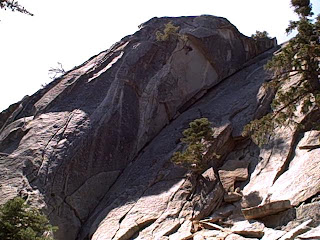
Looking up the North Buttress of Tahquitz Rock

We putted around at the base of the climb till I finally admitted that I had run out of delaying tactics and I started climbing. The climbing was very easy, just as I had planned. I even remembered some of the pin scars I saw along the way. It seemed like I was at the top of the pitch in no time. When Roy arrived at the first belay, he was muttering something about how I messed up. I demanded an explanation and he then informed me that I had climbed thirty to forty feet longer than the length of the rope. Our rope is two hundred feet long, so that means I climbed about two hundred and thirty feet, a rather long pitch. Of course you are saying, how does that work? How can you climb further than the rope is long and still have a belay? Well, the simple answer is, you can't. What happened is that when Roy couldn't get my attention and with the rope still moving up, he quickly started climbing after me and we ended up doing a technique called simul-climbing. This is most often used by mountaineers on long routes, trying to save time and climbing together, being careful to keep their spacing the same. If one falls, the other is pulled off the climb. The more slack in the rope, the more distance the one who is pulled off falls. Another factor is how much protection is placed and how far apart. I won't go into a lot of detail, but the fall factor was a bit excessive. We have experimented with small portable radios in the past, we may need to revisit them to prevent this from happening again.

Roy climbing first pitch

Roy explaining I climbed too far

Looking up 2nd pitch


Roy near top of second pitch

Once I got over my surprise at how long the first pitch was, I started off on the second. It was more of the same. Easy climbing in a beautiful setting. This time I did better and stopped before the end of the rope. This was one of the busiest days we'd seen on the rock this season, so we watched several other parties climbing the Whodunit, Long Climb and Snakes on Everything. Since the climb is fairly easy, rated 5.5 I was starting to look at alternate route choices. By the third pitch I had decided not to get too carried away and stay out on the buttress proper as much as possible.

Looking down third pitch

As we progressed up the third pitch, we were coming to the point where our climb would soon be joining other routes for the final pitches to the summit. I knew that we would want to go to our left, so I started working my way that direction. We were getting close to the top of the Larks and the angle of the rock started getting steeper and steeper. We the climbing becoming more vertical, it was also getting more challenging, but I was still having fun. 

Roy climbing fourth pitch

Then, on the fourth pitch, things came to a sudden stop. The very enjoyable crack I had been following became a seam. That wouldn't be a problem if I didn't have this overwhelming need for placing protection when I lead. This need becomes stronger the steeper and more technically challenging the climbing becomes. I decided that I could go out on unprotected face climbing for about fifteen feet and then continue up, but I thought my need would be left unmet. I moved back to the right and brought up Roy. I then realized that the situation was as bad, if not worse going up from our belay. I then went back to the left and did some delicate face moves to where I had another crack system going up. This crack system proved to be the key to our now modified route, even if the opportunities for protection were few and far between. If someone other than Roy was climbing with me, they would have thought that I was being bold, when in reality I just had no choice. Roy said it seemed like about two hours later I finally brought him up. He wasted no time in telling me that he never wanted to do this climb again. He felt the climbing was too "out there" even though he was on top rope. I told him that I was certain we wouldn't do this climb, or least this variation, again.

Racking gear at the belay

The fifth pitch took us almost to the top and we were on familiar ground as we joined the other routes. On this pitch we saw two kinds of berries and a plant with dark green leaves with brilliant scarlet edges. It would make a perfect Christmas plant, although a little small.


Looking down the route from the top of the fifth pitch

Roy belaying at top of fifth pitch, good exposure

The final pitch, our sixth, landed us on the summit shoulder. You would think that we would learn our lesson and stay on the normal route, but no, I had to see if I could make a traverse off the rock instead of going to the normal top of the climb. I didn't get very far and saw the futility of my plan and soon was back on track. 

This traverse didn't go

A half pitch later and we were on top. Roy then led over to where we could access the east gully descent route and we finished our drinks and snacks. Soon we were heading down to the car and the drive back to the desert heat.

The tree marks top of our route

Roy at the end of the climb, don't believe the smile

Jump, I've got you!

If you look here, you can see that this rock has moved


Here is a video of the climb